

بِسْمِ اللَّـهِ الرَّحْمَـٰنِ الرَّحِيمِ
Challenge Overview
The challenge is about a RaaS (Ransomware as a Service) product made by صديق البرنامج Ragab Ganbar, authored by 0xreizouko (烈火).
Extracting the challenge archive with the standard malware sample password infected yields three files:
Metoubas.exe
Metoubas.dll
flag.metoubas
1. Basic Static Analysis
Starting with basic static analysis using Detect It Easy (DIE) to inspect the packaging and compiler toolchain:
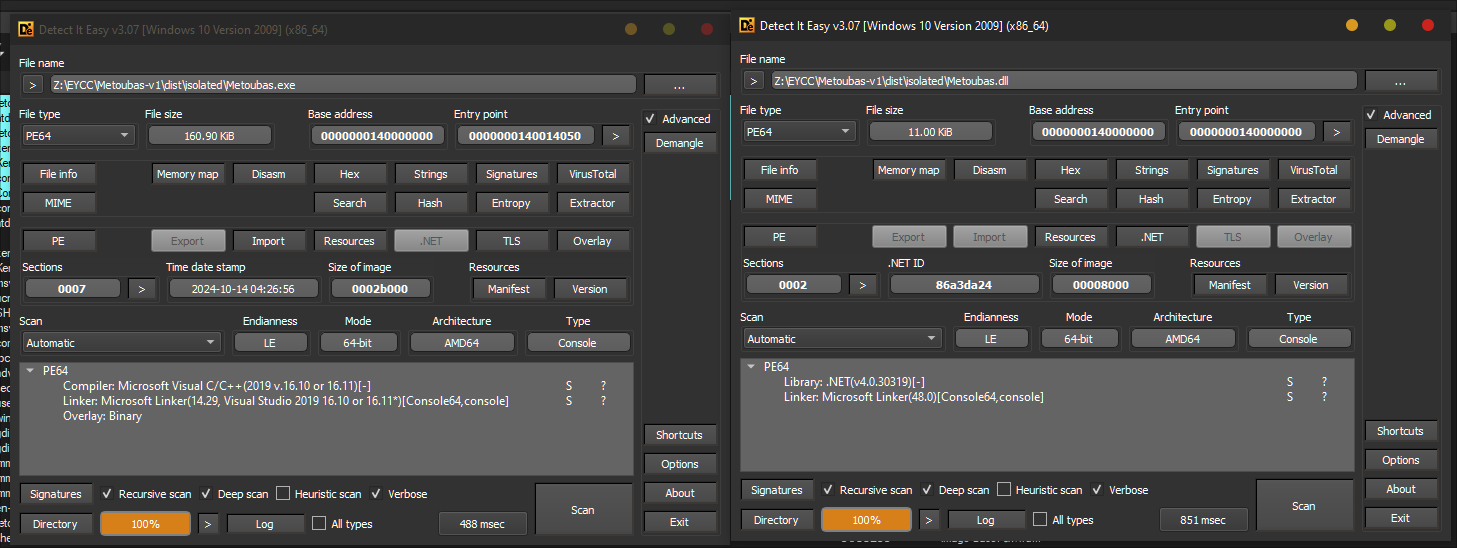
The .exe file is a native .NET bootstrapper (standard for .NET 5+), while the actual managed bytecode lives inside Metoubas.dll.
2. Dynamic Behavioral Analysis
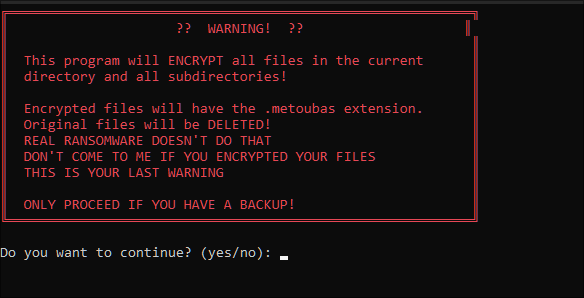
Running the executable triggers a warning dialog added for players monitoring sample behavior:
Running the sample in a controlled directory with Process Monitor (ProcMon) attached:
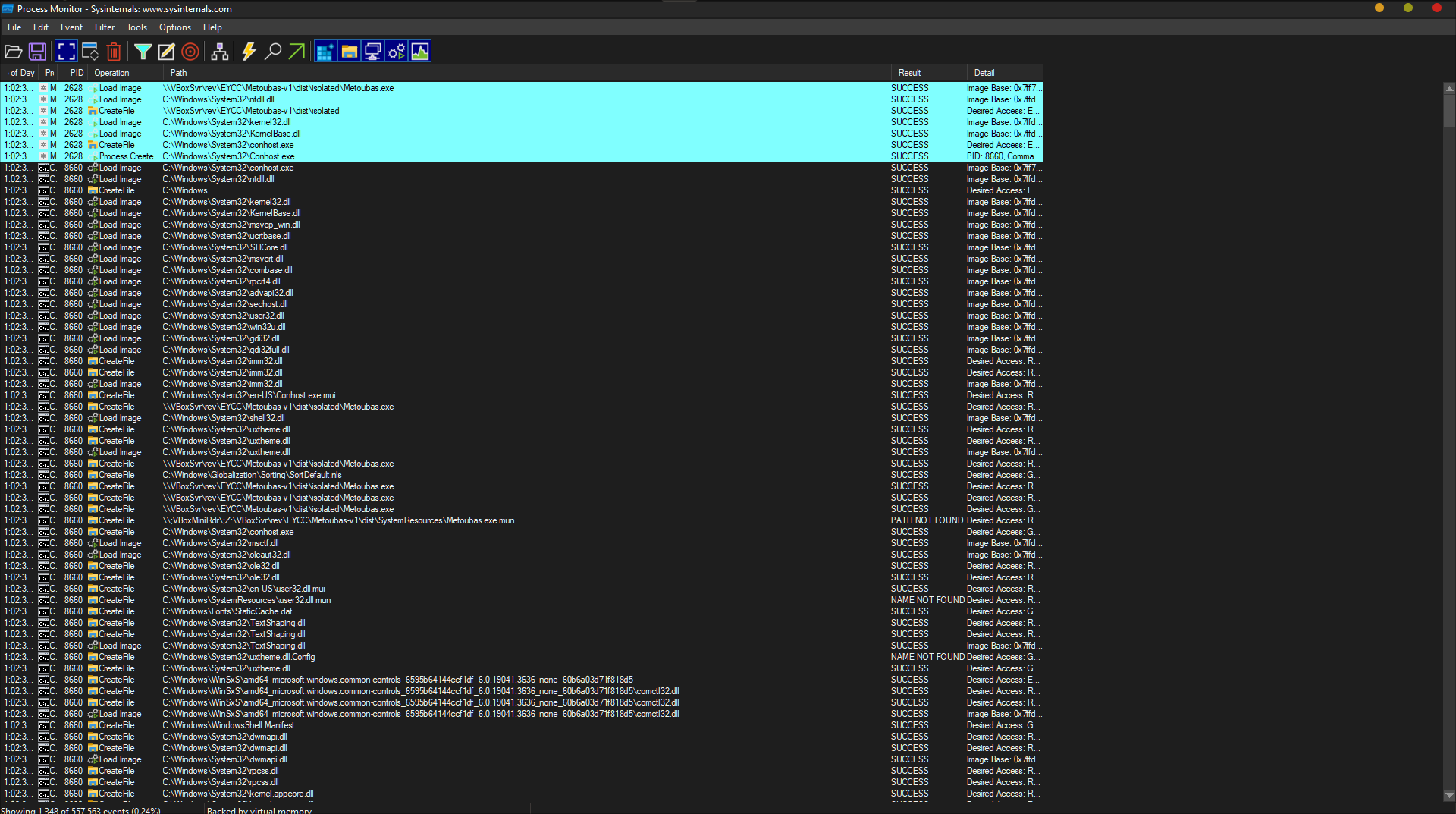
Filtering and highlighting the process image activity shows the executable reading files in the working directory, writing out .metoubas encrypted versions, and subsequently deleting the original source files (Delete: True):

3. Advanced Static Analysis (.NET Decompilation)
Opening Metoubas.dll in dnSpy (or ILSpy / dotPeek):
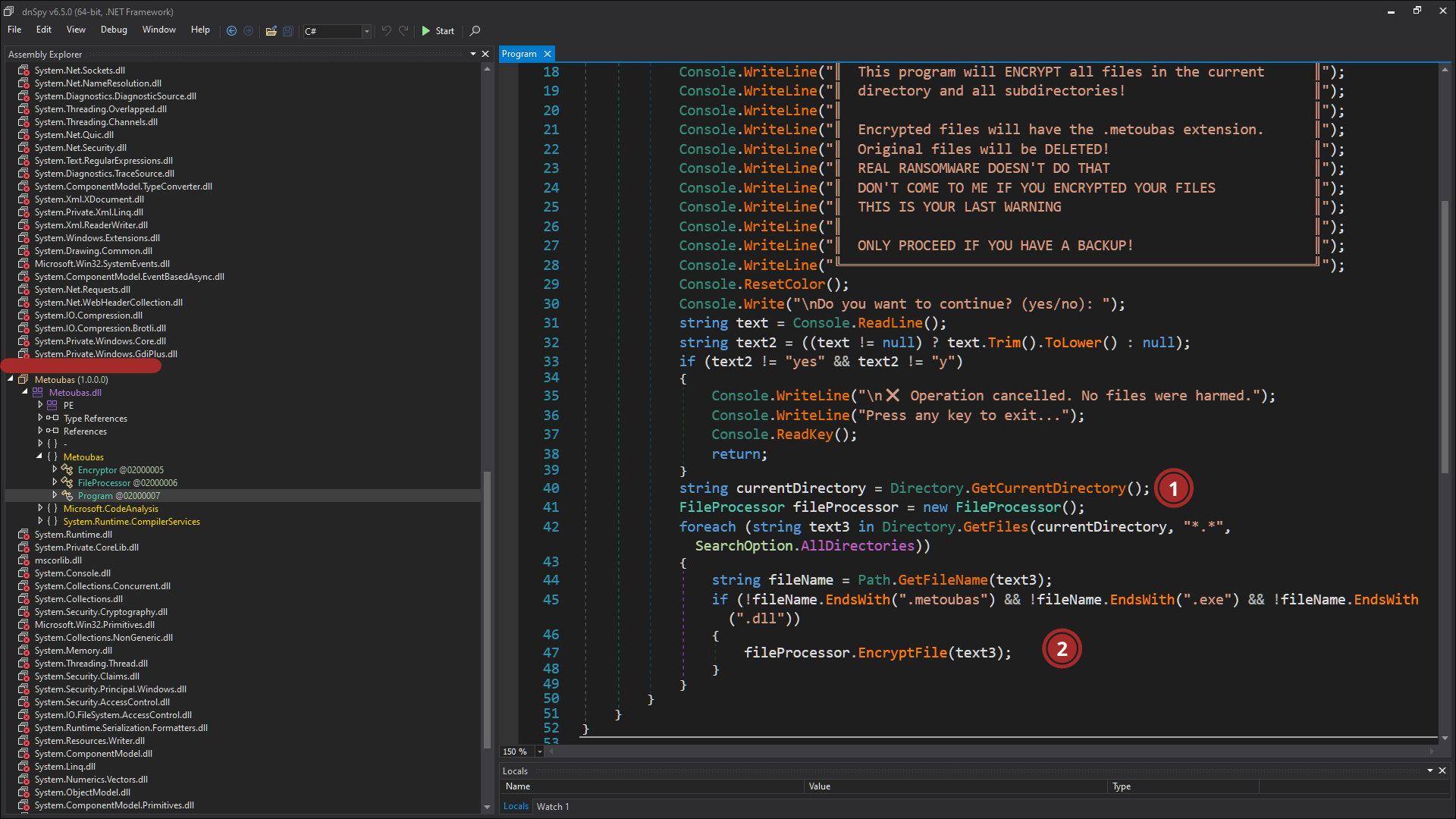
Navigating to the entry point reveals the execution flow:
- Retrieves the current directory and instantiates a
FileProcessorobject. - Iterates over all files in the directory, skipping the binary itself and any previously encrypted targets.
Inspecting FileProcessor
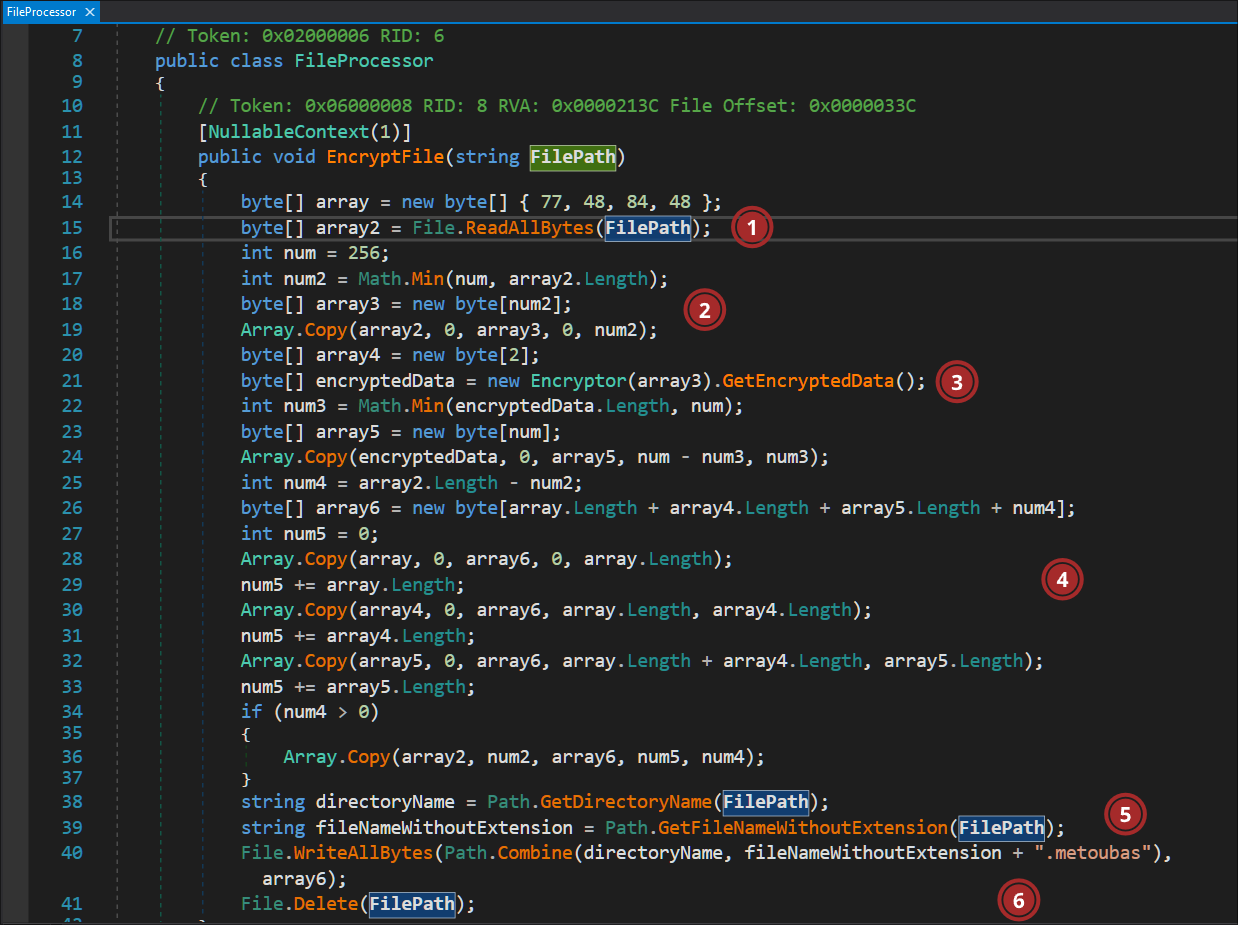
- Reads the target file content into memory.
- Buffers the data (chunk size 256 bytes due to encryption constraints).
- Executes the cryptographic transformation via the
Encryptorclass. - Prepends the custom 4-byte magic signature
M0T0+ 2 bytes padding followed by the ciphertext. - Writes the ciphertext to
<filename>.metoubasand deletes the original file.
Cryptographic Analysis: Low-Exponent RSA
Inspecting the Encryptor routine:
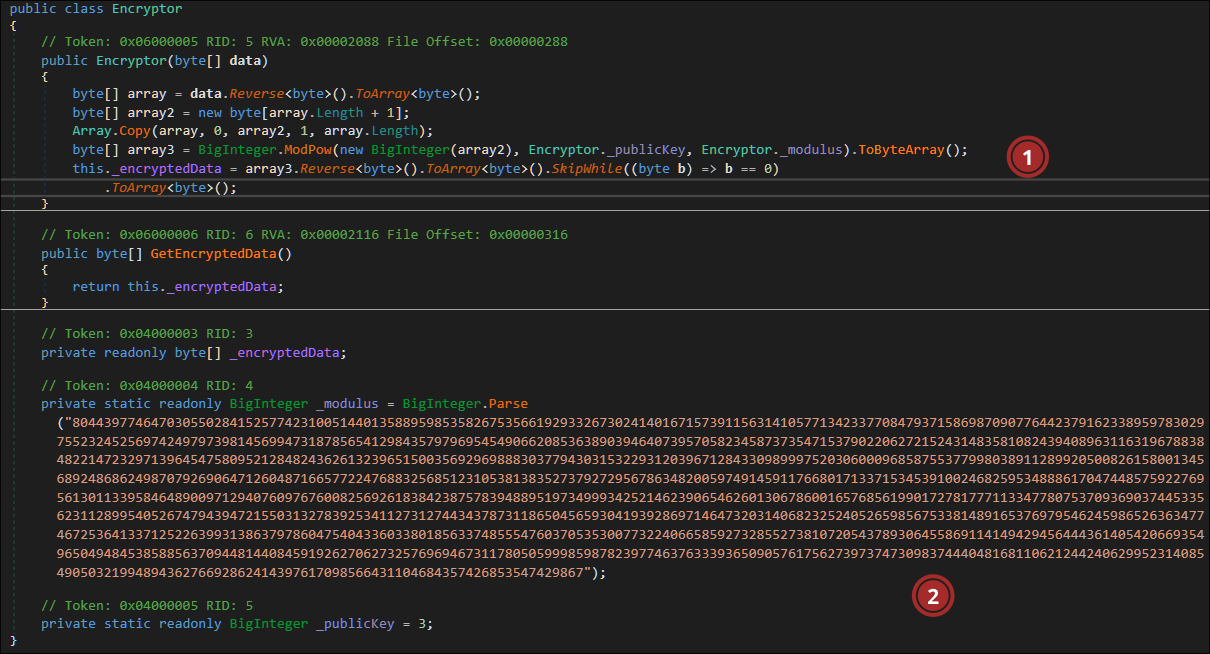
The encryption utilizes System.Numerics.BigInteger.ModPow:
public static BigInteger ModPow(BigInteger value, BigInteger exponent, BigInteger modulus);The algorithm reverses the byte arrays for endianness correction and performs modular exponentiation:
$$c \equiv m^e \pmod n$$

From the parameters:
- Public Exponent ($e$):
3 - Modulus ($n$): 2048-bit BigInteger
Because the public exponent $e = 3$ is extremely small and the plaintext message $m$ satisfies $m^3 < n$, the modulus wrap-around never occurs ($c = m^3$). This makes the encryption vulnerable to a direct Cube Root Attack (low public exponent attack).
4. Exploitation & Decryption
To decrypt flag.metoubas:
- Strip the header magic bytes (
M0T0) and padding from the encrypted file using a hex editor (010 Editor / HxD):
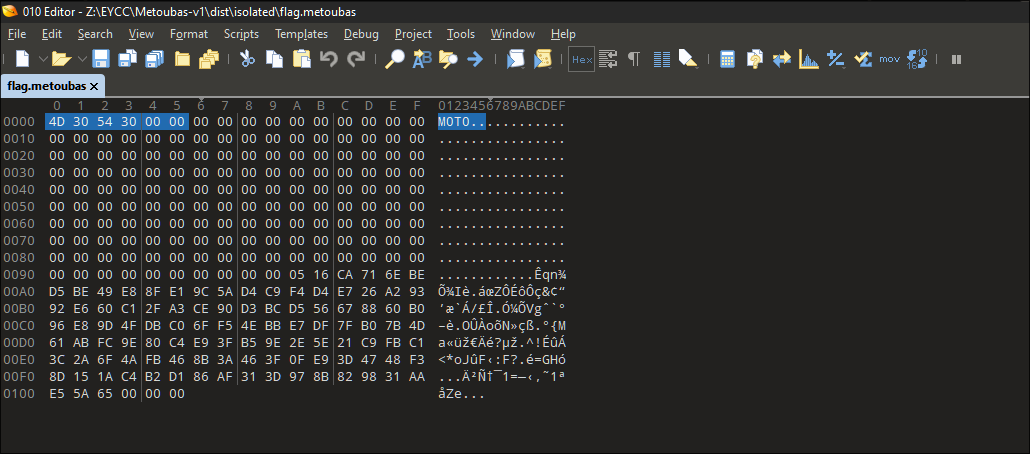
- Run RsaCtfTool with the extracted modulus $n$ and public key $e = 3$:
rsactftool -n <modulus> -e 3 --decryptfile flag.metoubas --attack cube_root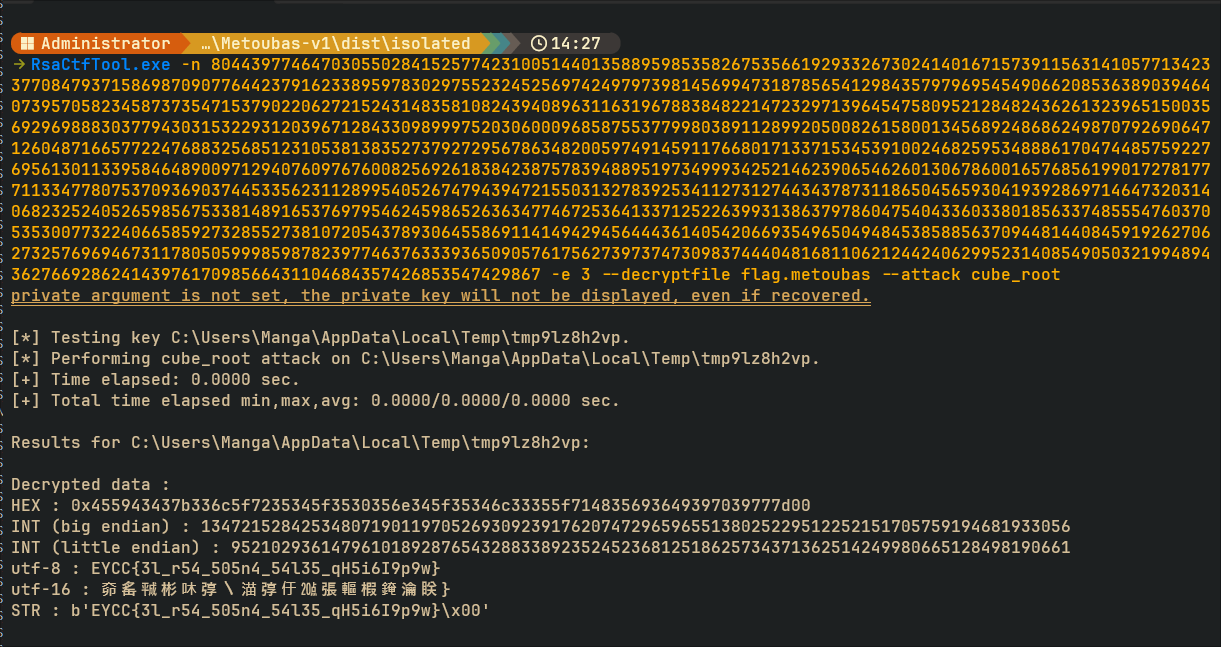
The decrypted plaintext reveals the flag.
📚 References & Further Reading
- Reversing Crypto Functions — GoggleHeadedHacker
- How To Identify Unknown Crypto Functions — OALabs
- Recognizing Common Cryptographic Algorithms - Encryption (PDF)
- Maharahtech — Symmetric vs. Asymmetric Encryption
- Maharahtech — Recognizing Encrypted Data & Entropy
- Maharahtech — Decompiling & Debugging .NET Binaries